Tuesday, October 6, 2009

Panch Phoran


Five-spice mix is an Indian spice blend typically consisting of five whole spices in equal measure.

Panch means ‘five’ and phoron is ‘flavor’ or ‘spice’, hence the common translation Bengali ‘Five-Spice’. Panch phoran is a colorful blend of flavorful seeds: the green of fennel seed, black mustard and nigella seeds, golden fenugreek and buff-colored cumin seeds.

Ingredients:

Method:

Mix all the above ingredients and store in an airtight container.

How to use:

Panch phoran is usually fried in hot oil or ghee before adding anything else to the pot in which cooking is to be done. These seeds pop up in the hot oil releasing the aroma of the seeds in the oil. Other ingredients are added when seeds stop spluttering. The panch phoran mixture adds sweetness and brings forward the flavors of vegetables, fish or lentils.

Variations:

Some variations include wild onion seeds instead of cumin, while others include radhuni seeds in place of mustard seeds.

Radhuni is also known as wild celery in English or ajmod in Urdu and Hindi. It is a very strong spice, with a characteristic smell similar to parsley with the taste of celery.

In the tradition of Oriya and Bengali cuisine, seeds are used whole and quickly fried in very hot oil until they crackle. Vegetables (especially potatoes), lentils, or fish are added to the cooking vessel after this to coat with the spice mixture.


Recipes :

Tilapia Tomato Curry

Baingan Ki Sabji


Monday, October 5, 2009

Radish Greens (Mooli Ke Patton Ki Sabji)


Radishes are tangy, mustardy root vegetables which add both flavor and nutrition to the food. The entire plant is edible.

The tops of tender radishes can be used as a leaf vegetable and the white root part can be eaten raw in salads as well as in many other dishes like Mooli Ka Paratha or Mooli Ke Kofte

Radish greens should be washed thoroughly in cold water. It is better to soak greens for about 30 minutes in very cold water before chopping and cooking them.

Ingredients:

  • Greens of 4-5 radishes finely chopped crosswise
  • ½ tsp chili flakes
  • ½ tsp turmeric powder
  • ½ red chili powder
  • Salt to taste
  • 1 whole dry red chili
  • Pinch of asafetida
  • 2 cloves of garlic chopped
  • 2 tbsp Cooking oil

Method:

  • Heat oil in a skillet. When hot add garlic pieces and fry till they are light pink.
  • Add asafetida, dry red chili, chili flakes and chopped Mustard Greens in the same sequence. Stir fry well. Add red chili powder, turmeric powder and salt.
  • Cook covered till it is tender (do not add water).
  • Take out in a serving dish.
  • Eat with hot roti (Indian flat bread) and dal of your choice.

Do You Know?

Radishes are a wonderful food for weight loss. Eating radishes actually makes you feel full because they are high in roughage and water. If you are on a diet, the high nutritional content, combined with the low calories, makes radishes excellent additions to light foods that could use the extra kick.

Sunday, October 4, 2009

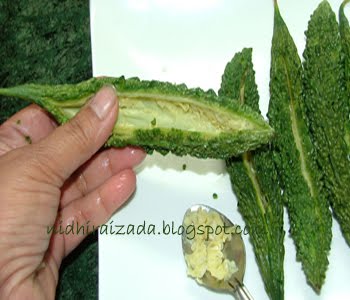
Bharvaan Karela (Stuffed Bitter Melon)


I am a ‘Karela’ fan. Give me Karela/Bitter Melon in any form I. ..will. ..enjoy… it. I believe if you ‘debitter’ the Karela, you insult Karela because this bitterness only is its identity……afterall it is called bitter melon.
In this recipe unpeeled bitter melon is stuffed with spices and then cooked on slow fire.
Karela becomes more tasty when it is eaten next day of its preparation. Try it!!!

Ingredients:

Method:
  • Wash the karelas. Cut off top and tail if Karelas are not tender.
  • Slit them through lengthwise .


  • Carefully, use a spoon to scoop out the pith. Discard the pith.
  • If pith is hard to remove then boil enough water in a pan and add one tsp of salt to water. Dip the karelas in this water and off the flame. Cover the pan and leave karela in this hot water for ten minutes. Remove karela from water,wash in cold water, cool and take out the pith with seeds.


  • In a heavy bottom pan heat 2 tbsp oil, fry onion and ginger garlic paste. Add all dry spices along with fennel seeds and little salt. Add 2 tbsp of water and fry well. Remove this masala in a plate and cool it.
  • Stuff karelas with this mixture.


  • Heat remaining oil in the same heavy bottom pan and add stuffed karelas. Cover the pan and let the karelas cook on slow heat till the karelas are done.


  • Stir occasionally but do it gently so as to avoid knocking the filling out of the karelas. Remember do not add water while cooking on slow fire. When done take out in a dish.
  • Serve with Roti and Dal of your choice.

Note: The Karela should be green and tender since it becomes more bitter as it ripens.


Tip: A traditional way to ‘debitter’ the karela is, to peel off the skin and cut into thin slices or slitted. It is salted and exposed to direct sunlight for few hours to reduce its bitterness. After few hours, it's salty, bitter water is reduced by squeezing out the excess by hand. Then it's rinsed with water a few times.


Do You Know?
Bitter Melon, also known as Karela or Momordica charantia is a herb that helps regulate blood sugar levels and keeps body functions operating normally. It contains Gurmarin, a polypeptide considered to be similar to bovine insulin, which has been shown in experimental studies to achieve a positive sugar regulating effect by suppressing the neural response to sweet taste stimuli.
The fruits have long been used in India as a folk remedy for Diabetes mellitus.

Friday, October 2, 2009

Beetroot Fugath (Chukandar Fugath)


Fugath is very common in Mangalore and Goa parts of India. I learnt this recipe from my Mangalorean friend.

Fugath is the term used for any vegetable dish made with coconut and curry leaves. The ingredients are few and the recipe very simple.

Fugath goes very well with roti/Paratha and dal.


Ingredients:

Method:

  • Boil beetroots in water. It takes little less time than the potato of the same size when boiled. Drain the beetroots, and cut into small cubes (less than one cm).
  • Heat the oil in a shallow pan and add mustard seeds. When they stop spluttering add the urad dal, curry leaves and green chilies and sauté a little.
  • Add the beetroot cubes, salt to taste and stir fry for 2-3 minutes.
  • Add the grated coconut and mix well. Cook for another minute and then turn off the flame.
  • Garnish with some fresh grated coconut.
  • Serve with hot roti (Indian flatbread) or Paratha and a dal of your choice.


Do You Know?

Mangaloreans are fairly health-conscious; they like to use jaggery that is made of palm and not sugarcane.

They use some uncommon ingredients in their cooking like local spinach Besale, (which grows wildly and abundantly), raw banana and bamboo shoot.

Some fruits like jackfruit and breadfruit are used as vegetables in Mangalorean cooking.

Vegetable like Taute, a sweet cucumber, is treated like a fruit and used extensively in the making of Sambar.

Thursday, October 1, 2009

Shalgum Ka Gosht (Lamb with Turnips)


Mutton marinated in spiced yogurt mixture and cooked with turnips (Shalgum).

Ingredients:

Method:

  • Mix yogurt, coriander powder, red chili powder, turmeric powder, ginger garlic paste, and salt together. Marinate the lamb in this mixture for 1 hour.
  • Heat the oil in a large, wide, and preferably non stick pan over medium flame.
  • When hot put in the onions. Stir and fry until the onions are reddish brown color. Remove the onions with slotted spoon, squeezing out and leaving behind as much oil as you can. Keep a little of brown onion slices aside to garnish the dish and put the rest into the blender or food processor. Grind to a smooth paste.
  • Heat the oil that was left over from frying the onions, again.
  • Add bay leaf and cloves to it. After few seconds, add meat pieces without marinade and fry for 5-6 minutes on high heat, stirring every now and then.
  • Now add the onion paste and marinade to the meat. Turn the heat down to medium and continue to stir and fry till the oil begins to separate from the meat masala. Sprinkle a little water whenever the masala begins to stick to the pan or burn. Season it with salt to taste.
  • Now put in 2-3 cups of water and turnips. Bring the pan to a boil. Turn the heat to medium low and cook covered (At this stage you can transfer meat turnip mixture in a pressure cooker to cook it faster).
  • When the meat is cooked and tender, remove the pan from the heat and sprinkle the garam masala over it. Cover and simmer on low heat for 2-3 minutes.
  • Open the cover and garnish with previously fried onions and chopped fresh coriander leaves.
  • Serve with hot roti (Indian flat bread).


Do You Know?

Turnips are a member of the cruciferous family, along with broccoli, cauliflower, Brussels sprouts, cabbage etc.

Turnips are extremely rich in folic acid which is necessary for cell growth. Folic acid (folate) is crucial for cell reproduction within a fetus. Pregnant women are often advised to get extra amounts of folic acid. Most dark green vegetables are high in folic acid.


Wednesday, September 30, 2009

Garam Masala


Garam Masala is the most aromatic and fragrant of all Indian spice blends. It is used throughout North India in all types of dishes, from appetizers and soups to yogurt salad and main courses. This blend is indispensable to Moghul and North Indian cooking.

Garam means ‘hot’ or ‘heating’ and masala means ‘spice blend’. The ‘hot’ is not necessarily referring to the kind of heat we find in hot chilies but to the fact that the spices are first roasted then ground. Another explanation given is that the combined effect of the spices in garam masala increases body temperature. Black pepper and cinnamon which are present in the garam masala carry some heat.

Different regions use different combinations of various herbs and spices. The blends also vary from household to household where proportions may vary according to whatever dish it is being used to season.

Ground garam masala is usually added at the end of cooking but I sometimes prefer adding garam masala along with other spices at the beginning of the cooking especially in the case of some meat dishes. This gives different color and flavor to the dish.

Garam Masala powder is easily available in Indian Grocery stores but homemade is more fragrant and fresher.

Garam masala is best made fresh just before cooking, but can be made ahead and stored for about 3 months in an air-tight container in a cool, dark place.


Garam Masala Recipe I

This milder version of garam masala is based on the cumin and coriander in combination of sweet spices like cardamoms and cinnamon.

It can be added at the end of the cooking or may even be sprinkled to a dish after serving.

Ingredients:

Method:

  • Heat a heavy skillet over medium heat.
  • Dry roast the peppercorns, stirring frequently, about 3-4 minutes until aromatic. Turn out into a bowl.
  • Repeat with the remaining spices, roasting one at a time until fragrant and stirring to prevent burning.
  • Once cooled, grind them all together, to a fine powder in a clean, dry coffee grinder.
  • Sieve garam masala powder and discard fibers from the skin of the cardamoms.
  • Store it in an air-tight container in a cool, dark place.

Garam Masala Recipes:

  1. Sabut Dal Mix
  2. Chana Dal with Bottle Gourd
  3. Paneer 65
  4. Egg Kofta
  5. Amla Sabji
  6. Masoor Dal Kebabs


Garam Masala Recipe II

I use this recipe for Vegetarian dishes. All ingredients are easily available in Indian Grocery Stores.

Ingredients:

Method:

  • Heat a heavy skillet on a medium flame and gently roast all ingredients, one at a time, except the dry ginger, till they turn a few shades darker and fragrant. Stir them frequently to prevent burning.
  • When the spices are roasted turn off the flame and allow them to cool.
  • Once cooled, grind them all together, to a fine powder in a clean, dry coffee grinder.
  • Sieve garam masala powder and discard fibers from the skin of the black cardamoms.
  • Store in an air-tight container in a cool, dark place.

Garam Masala Recipes:

  1. Black-eyed Beans
  2. Mah Ki Dal
  3. Dum Aloo
  4. Paneer Kofta Curry
  5. Chicken Sagwala
  6. 'Yolk Up' Egg Curry
  7. Ghiya Ke Chhilke


Garam Masala Recipe III

This recipe makes more aromatic and hot garam masala. I prefer to use this garam masala powder in Mughlai non vegetarian dishes.

All ingredients are easily available in Indian Grocery Stores.

Ingredients:

Method:

  • Heat a heavy skillet on a medium flame and gently roast all ingredients except the dry ginger, till they turn a few shades darker.
  • Turn off the flame and allow them to cool.
  • Grind them all together, to a fine powder in a clean, dry coffee grinder.
  • Sieve garam masala powder and discard fibers from the skin of the black cardamoms.
  • Store in an airtight container in a cool dark place.

Garam Masala Recipes:

  1. Keema Stuffed Tomatoes
  2. Rogan Josh
  3. Kidney Masala
  4. Chicken Kadhai Wala
  5. Ginger Chicken
  6. Shahi Chicken Curry
  7. Lamb Chops

Sabut Dal Mix (Mixed Whole Lentils)


This dal is a combination of sabut dals (whole ) which are highly nutritious. Liberal use of ‘tadaka’ (tempering) enhances the flavor of dal mix.

Serve dal with Nan or Tandoori Roti.

Ingredients:

  • ¼ cup Sabut Moong (whole Green Gram)
  • ¼ cup Sabut Urad (whole Black Gram)
  • ¼ cup Sabut Masoor Dal (whole Red Lentil)
  • ¼ cup Chana Dal ( Bengal Gram)
  • 2 tbsp cooking oil
  • 1 medium onion finely chopped
  • 4-5 cloves of garlic finely chopped
  • 1” ginger finely chopped
  • 1 small tomato finely chopped
  • 2-3 green chilies finely chopped
  • 1 tsp turmeric powder
  • 2 tsp red chili powder
  • A pinch of asafetida
  • 1 tsp cumin seeds
  • 1 whole dry red chili
  • 1 tsp garam masala
  • 6 tbsp ghee (clarified butter) for tempering
  • 2 tbsp Lemon Juice
  • Onion/green chili/chopped coriander to garnish

Method:

  • Mix Sabut Masoor, Chana Dal, Sabut Urad, Sabut Moong in a bowl and wash thoroughly. Soak the washed dals in water deep enough to cover them completely, for 2 hours.
  • After 2 hours put dals in a pressure cooker. Add 4 cups of water, green chilies, 1 tsp red chili powder, turmeric powder, salt and 2 tbsp of cooking oil. Stir well.
  • Cover the pressure cooker and set on the stove at a high flame. After the first 'whistle' or ‘pressure release’, reduce the flame to simmer and cook for 2-3 more ‘whistle’. Turn off the flame and allow the pressure cooker to cool.
  • Open the pressure cooker when cooled, stir the boiled lentils very carefully and add salt. If it is too thick, add some warm water and stir carefully until the consistency is right.
  • In a small pan, heat 3-4 tbsp ghee on medium heat. When hot, add the cumin seeds and fry till spluttering stops. Now add the chopped onion, chopped ginger and garlic, chopped tomatoes, and fry for 4-5 minutes till tomato is pulpy. Remove ghee from fire and add to the dal mixture. Stir to blend and simmer for 2 more minutes.
  • Remove dal mix from fire, put into serving dish, mix fresh lemon juice and garam masala.
  • ‘Tadka’ (tempering) for garnishing: Heat 2 tbsp ghee in a small pan on medium flame. When hot add asafetida, whole red chili and 1 tsp of red chili powder. Remove from fire and immediately pour over dal mix before chili gets burnt.
  • Garnish with raw onion slice and green chili and chopped coriander leaves.
  • Serve with Nan or Tandoori Roti

Do You Know?

Consumption of wholegrain has been consistently linked with a significant decrease in risk factors for cardiovascular disease. Regular wholegrain consumption lowers LDL and triglyceride levels, which contributes to reduction in coronary heart disease risk factors.

In addition, wholegrain consumption is inversely related to hypertension, diabetes, and obesity when compared to refined grains, all of which are negative indicators in total cardiovascular health.